The best Side of drilling fluid loss
Wiki Article
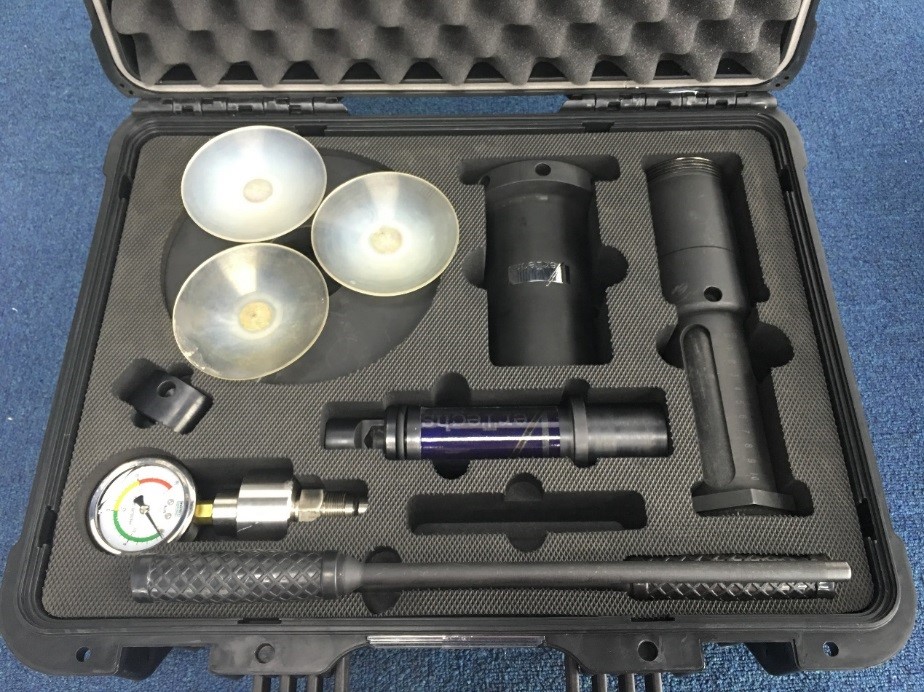
(3) The experimental evaluation way of the drilling fluid lost control performance thinking about a variety of loss kinds is recognized. Based on the Assessment way of the experimental outcomes from the drilling fluid lost control efficiency, the indoor evaluation system with the highest coincidence diploma While using the on-internet site drilling fluid lost control performance is received, such as the peak from the fracture module with the very best coincidence diploma, fracture inclination, fracture surface roughness, pressurization mode, single pressure increase, and strain stabilization time.
The paper will protect the next main topics: Deep nicely drilling systems are of vital relevance in the drilling business. In this method, the drilling fluid (drilling mud) is used to maintain force balance, great the drilling Device, and take away cuttings
Determine 6b demonstrates that, throughout circulation, drilling fluid flows downward inside the drill pipe. Owing to the relatively sleek inner wall of your drill pipe, frictional strain losses are minimal. In addition, gravitational possible Strength converts to kinetic Vitality in the course of downward movement, causing a progressive boost in fluid velocity along the drill pipe. For the bit nozzle exit, move constriction induces substantial frictional force losses, additional accelerating fluid velocity close to the wellbore bottom. Conversely, as fluid exits the drill pipe and enters the annulus for upward move, velocity little by little decreases resulting from high wall roughness plus the conversion of kinetic Electrical power back to gravitational prospective energy. The upward velocity is considerably lower compared to the downward velocity within the drill pipe. Area observations indicate that an entire drilling fluid cycle comprises downward and upward phases, Using the upward section duration noticeably exceeding the downward stage. The velocity distribution in Figure 6b points out this phenomenon. Ahead of loss initiation, no fluid flows within shut fractures; So, velocity remains zero during.
A two-section circulation design for drilling fluid throughout the wellbore–fracture process was founded dependant on the Eulerian–Eulerian approach, incorporating dynamic BHP and reliable-stage distribution results into your loss course of action simulation.
Drilling fluids are complicated multiphase systems made up of a liquid section as well as a large focus of stable-phase particles, which primarily consist of bentonite, barite, cuttings as well as other typical treatment options in drilling fluid. The strong-phase written content of drilling fluid is often 20–forty%, and the scale of those stable-period particles is often fewer than 100 μm, that happen to be uniformly dispersed inside the drilling fluid. For that reason, the loss problem of drilling fluid in the coupled wellbore–fracture technique is a normal multiphase movement dilemma. Widespread multiphase stream products primarily include things like the Euler–Euler model plus the Euler–Lagrange product [33]. The Euler–Lagrange model mostly concentrates on monitoring the trajectory of just one particle along with the transform in its encompassing flow area, as well as interactions concerning the microscopic Homes of an individual particle, particle–particle, particle–fluid, and particle–boundary are non-negligible for two-section flow habits.
. Fluid loss can arise once the strain of your drilling fluid is lessen as opposed to development tension. Drilling parameters should also be cautiously monitored. Superior drilling speeds or inappropriate drilling methods improve the danger of fluid loss. The consequences of fluid loss may be intense.
(2) The key control factors with the drilling fluid lost control efficiency of various loss sorts and the burden ratio of principal control elements are defined. For induced fracture loss, the most beneficial fracture height, fracture dip angle, fracture area roughness, the ideal pressurization mode, solitary pressure improve, and strain stabilization time are outlined In order to evaluate the drilling fluid lost control performance systematically.
Typical models for predicting mud loss are restricted by simplified assumptions, linear correlations, and website-unique heuristics, which hinder their accuracy and adaptability in intricate drilling environments. They generally fall short to generalize throughout assorted geological problems and so are more weakened by reliance on small or artificial datasets.
This paper will examine measures to beat fluid loss and using new technologies. When specializing in the main leads to and effects of fluid loss, we see that it may take place for several reasons.
Very well D can be an analysis properly located in Block K of the Tarim Basin, and it has made micro-fractures. When drilling to the properly depth of 5694�?819 m, loss happened.
3rd stage—the steady loss stage of drilling fluid: As shown in Determine 8a, the return flow of drilling fluid inside the annulus gradually rises This Site and finally stays regular. In distinction, the curve of loss amount of drilling fluid steadily decreases until eventually it truly is flat. At the moment, there is a continuing distinction between the return move in the annulus as well as drilling displacement, setting up a different dynamic balance. The curve in the cumulative loss of drilling fluid rises linearly, so the full volume of drilling fluid in the field decreases at a relentless fee, as well as the liquid stage decreases uniformly. The strain response during the loss system corresponds to the changes in flow rate almost everywhere. Determine 8b reveals the changes in various pressures over time in the course of the total loss approach. The pressure curve from the fracture rises bit by bit and step by step will become flat. That is because of the minimize while in the invasion velocity of drilling fluid while in the fracture and the rise in the overall loss quantity. Once the drilling fluid flows out of the consistent fracture outlet, the volume of drilling fluid in the fracture isn't going to modify, along with the pressure inside the fracture stays continual. The BHP and standpipe pressure curves also rise and afterwards gradually grow to be flat.
Determine 10c displays that, Even though the depths on the thief zone are distinct, under the exact fracture geometric problems, the fluid pressure inside the fracture is similar throughout the steady loss stage, so the greater the BHP equivalent to the stable loss stage, the bigger the overbalanced tension. This points out why the loss charge of drilling fluid will increase with the increase in the thief zone depth in the steady loss phase. The loss of drilling fluid will bring on a lessen in standpipe stress, and the scale on the reduce in standpipe stress demonstrates the severity of drilling fluid loss. The loss amount of drilling fluid raises with the rise in perfectly depth, and the corresponding lessen in standpipe stress will also enhance with the rise in perfectly depth. The exploration effects of drilling fluid loss behavior at unique thief zone depths also make clear why, in the drilling means of deep tight oil and fuel reservoirs, big loss and severity loss usually take place within the lower formations, and the increase in perfectly depth will produce a bigger overbalanced strain.
The effects demonstrate that there's no evident distinction between the indoor and area drilling fluid lost control effectiveness in two distinct pressurization methods, along with the analysis results of your drilling fluid lost control performance are all “fantastic.�?Based on the Investigation, stepped pressurization gradually pushes the plugging content into the fracture by pressurization–stress stabilization–pressurization, even though continuous pressurization pumps the displacement fluid at a constant fee.
All claims expressed on this page are solely People of the authors and do not necessarily characterize Individuals in their affiliated organizations, or People with the publisher, the editors and the reviewers.